


Local hiring is slower and more expensive than ever. Offshore can look cheap on paper but often adds coordination overhead, time-zone friction, and quality risks that CTOs and CEOs end up paying for later. Budgets are tight, delivery timelines are tighter, and every hiring decision affects runway and product velocity.
This guide breaks down nearshore software development pricing in 2026 in practical terms: real hourly rates by region, what drives cost differences, hidden expenses to factor in, and how to model total cost beyond the headline rate. If you need clear numbers and trade-offs to make a decision — read on.
Nearshore Software Development Rates And Cost Drivers
For SaaS scale-ups, nearshore software development rates are not random — they are driven by a predictable mix of variables: role, region, seniority, tech stack scarcity, project complexity, and engagement model (IT staff augmentation vs full nearshore teams).
In 2026, nearshore pricing across Latin America (LATAM) and Central & Eastern Europe (CEE) typically falls between $25 and $80 per hour. The same budget can buy a mid-level engineer in one region or a senior in another. The difference directly impacts delivery speed, architecture quality, and long-term total cost of ownership.
Compared to onshore hiring in the US or UK, cost of nearshore teams often reduce fully loaded costs by 30–50%. However, the real financial advantage depends on how senior the team is, how complex the product is, and whether you are augmenting internally or outsourcing delivery ownership.
Need senior nearshore talent that delivers from day one?
Nearshore Software Development Pricing by Role and Region
Factors like role and geography impact the rates. LATAM is often slightly more affordable, especially for US-based companies seeking time-zone alignment. CEE typically commands higher rates due to a strong senior engineering base and complex system expertise.
| Role / Region | LATAM (e.g., Mexico, Brazil) | CEE (e.g., Poland, Ukraine) |
|---|---|---|
| Junior Developer | $20–$35 | $25–$40 |
| Mid-Level Developer | $30–$50 | $35–$55 |
| Senior Developer | $40–$65 | $50–$80 |
| QA / DevOps | $25–$55 | $30–$65 |
For the same $8,000 monthly budget, you may hire a senior engineer in LATAM or a strong mid-to-senior in CEE — but the latter may bring deeper architecture experience.
Nearshore Development Cost by Expertise and Seniority
Seniority is one of the strongest pricing drivers. It affects not only hourly rate but also delivery speed and rework risk.
| Seniority Level | Typical Rate (USD/hour) |
|---|---|
| Junior | $25–$40 |
| Mid-Level | $35–$55 |
| Senior | $50–$80+ |
Juniors reduce short-term cost but require oversight. Seniors increase hourly cost yet often lower total project cost because they prevent architectural mistakes and boost decision-making.
Nearshore Development Rates by Tech Stack
Stack scarcity directly shifts pricing. Commodity stacks remain affordable; specialized or enterprise-heavy stacks command premiums.
| Tech Stack | LATAM | CEE |
|---|---|---|
| JavaScript (React/Node) | $20–$45 | $20–$40 |
| Python | $25–$50 | $25–$45 |
| .NET / Java | $35–$60 | $40–$70 |
| Mobile (iOS/Android) | $30–$55 | $30–$60 |
AI/ML, data engineering, and cloud architecture roles often exceed these bands due to global demand.
Nearshore Software Development Rates by Project Complexity
Hourly rates do not change drastically with complexity — team composition does.
| Project Complexity | Typical Effective Rate |
|---|---|
| Simple (MVP, CRUD apps) | $50–$70/hr equivalent |
| Medium (scalable SaaS modules) | $55–$75/hr |
| Complex (multi-tenant SaaS, integrations, high-load systems) | $65–$85+/hr |
More complex systems require senior engineers, architects, and DevOps from the start. While hourly cost rises moderately, total project budgets can range from $50,000 to $300,000+, depending on scope.
Potential Savings From Nearshore Development for SAAS Scale Ups

If your SaaS company is growing quickly, nearshore development can be a smart, cost-effective way to scale a software development team. Growth-stage teams that move part of their roadmap (say, 4–8 engineers) to nearshore regions typically reduce labor costs by 40–60% compared to US hiring. That alone can mean $200K–$400K in savings per year for a small squad.
Understanding how much does nearshore development usually cost compared with onshore or offshore options helps leaders plan their teams wisely. Nearshore rates usually fall between $25–$80 per hour, while US engineers often cost $100–$150 per hour — or $140K–$180K annually before overhead.
The benefits of IT staff augmentation go beyond hourly rates. Companies also save 20–30% on overhead — no benefits packages, no office space, no extra equipment budgets — which can mean another $20K–$30K per developer each year.
Unlike offshore setups (Asia, for example) that look cheaper on paper but often add 20–30% rework due to time zone gaps and communication delays, a nearshore staffing firm can increase productivity by 10–35% thanks to overlapping work hours. Conversations happen in real time instead of piling up overnight. That keeps releases on schedule and decisions moving.
For a mid-stage SaaS company burning $200K per month, shifting part of the tech talent nearshore can lower burn by 20–40% — often extending runway by 6 to 18 months without slowing product development.
Looking to scale your SaaS team more efficiently?
Cost Savings When Nearshoring to Central & Eastern Europe (CEE)
For Western and Northern European companies paying €60–€120 per hour locally, CEE rates of $30–$80 per hour typically mean 35–60% savings. For example, hiring in Poland at around €45 per hour can reduce costs by roughly 35% compared to Western Europe.
You also get practical advantages beyond the rate. With just 1–3 hours of overlap (GMT+1/2 and CET/UK), collaboration feels natural. For regulated SaaS products, EU compliance familiarity and cultural alignment often help senior developers ship faster — often by 20% or more. In real projects, the difference between nearshore vs offshore software development often comes down to how quickly decisions get made — and how much rework you avoid.
Cost Savings When Nearshoring to Latin America (LATAM)
In LATAM — think Mexico or Brazil — developers usually charge $25–$65 per hour, which still gives you big savings over hiring in-house. The huge perk here is almost full time-zone overlap with the US, so you can have real-time conversations with your team without staying up late or waiting for replies.
Beyond salary savings, LATAM teams tend to be stable, which reduces churn and the hidden costs of constantly onboarding new engineers. A dedicated team can save $300K or more per year, all while giving you access to skilled developers who can take on growing project scope in front end, back end, or mobile work.
That's why nearshore isn't just a cheaper alternative. It's a way to reduce costs while protecting delivery speed — something offshore models and fully in-house hiring don't always manage at the same time.
Potential Challenges From Nearshore Development In Different Regions
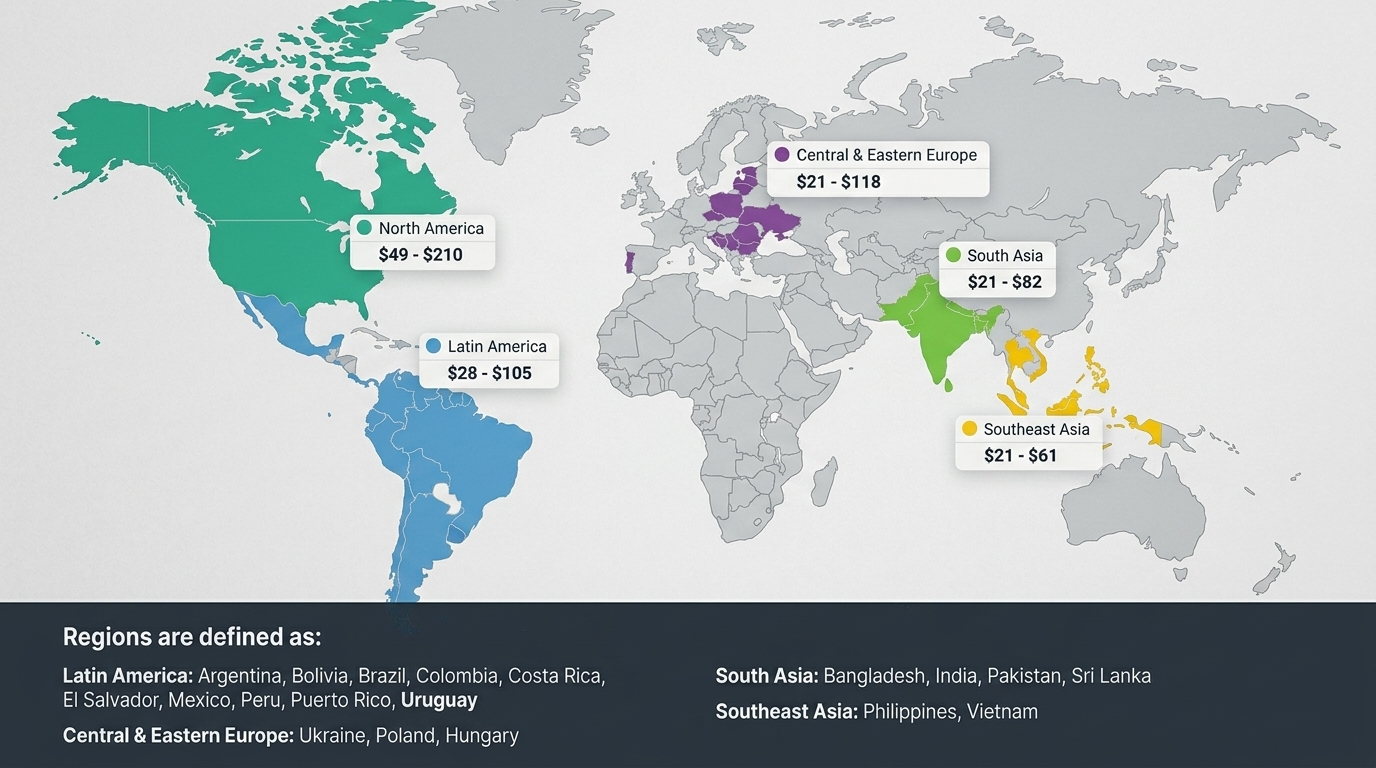
As everything else, nearshoring always involves trade-offs. When evaluating the costs of nearshore software development, it's important to look beyond the hourly rate. The real cost depends on many things like stability, legal clarity, infrastructure, and how easy it is to collaborate long term. CEE tends to concentrate risk around geopolitics and talent competition, while LATAM introduces more structural and legal complexity.
Here's what SaaS leaders should realistically factor into their cost comparison.
Challenges When Nearshoring to Central & Eastern Europe (CEE)
In CEE, the main concerns are geopolitical and competitive — not structural.
Ukraine's ongoing war understandably raises questions. While most tech hubs continue operating normally, temporary disruptions can affect around 10–20% of teams depending on location. Many companies mitigate this by working with distributed or hybrid setups (for example, combining Ukraine and Poland), which protects delivery continuity.
Another factor is talent competition. Strong technical expertise and EU market access mean experienced software engineers are actively recruited by Western companies. Annual churn can range from 15–25% in some markets. What helps reduce that risk is choosing the right IT outstaffing company with retention programs and a stable dedicated team model.
English proficiency is generally high across CEE, especially among mid-to-senior engineers. Accents or communication nuances may require minor alignment early on, but cultural compatibility with EU and UK clients is typically strong.
Overall, CEE challenges are manageable and mostly transparent. The region continues to offer high-quality engineering with predictable developer rates, especially for complex SaaS products requiring senior-level expertise.
MaybeWorks helps you set up a nearshore dev team that works seamlessly with your existing team, right from the start.
Challenges When Nearshoring to Latin America (LATAM)
LATAM can look attractive from a pure labor costs perspective, especially for US companies. However, the practical challenges tend to be broader and more operational.
Bureaucracy is one of the most common obstacles. Company registration, taxation rules, and compliance procedures can delay onboarding by 2–6 months in some countries. That directly affects ramp-up speed and the real cost breakdown of your engagement.
Infrastructure reliability varies significantly outside major hubs. In parts of Brazil or Mexico, power outages and unstable internet still occur. For distributed SaaS teams working in real time, even occasional disruptions can slow delivery.
Security and IP protection are another concern. Industry reports show higher exposure to vendor-related breaches compared to CEE markets. Weak security protocols or unclear legal enforcement can increase risk — especially for regulated SaaS products handling sensitive user data.
Legal disputes and labor law complexity can also affect long-term stability. Add economic volatility, inflation swings, or regional crime concerns, and the picture becomes less predictable for companies planning multi-year investing in product development.
Types of Nearshore Software Pricing Models

In the cost of nearshore, the pricing model matters just as much as the hourly rate. The structure you choose stands for budget predictability, delivery risk, and how easily you can adjust scope mid-flight.
You will usually encounter three main pricing models: fixed price, time and materials, and managed nearshore teams. To choose the right one, you'll have to decide whether you're leaning toward outstaffing vs. outsourcing — extending your internal team or handing over delivery ownership. Each works better for a different type of SaaS work, from clearly defined features to long-term product engineering.
Fixed Price for Predictable Scope
A fixed price model works best when the scope is clear and unlikely to change. You agree upfront on features, timeline, and total cost, and the vendor commits to delivering within that boundary.
This approach makes sense for:
- A well-defined integration with a third-party API
- A standalone front-end redesign
- A clearly scoped MVP with locked requirements
The advantage is budget certainty. Finance teams like it because they know exactly what they'll pay.
MaybeWorks' Approach:
When we use fixed-price models, we focus on upfront clarity — not just features, but acceptance criteria and success metrics. That way, clients know exactly what they're getting, and our developers can deliver efficiently without any ambiguity none of us wants. It's about minimizing surprises, not just locking in a number.
The trade-off is flexibility. If your product direction shifts or technical constraints change, adjustments can trigger change requests and renegotiations. For SaaS companies iterating quickly, that friction can slow things down.
Fixed price can help reduce costs when requirements are stable. But if your roadmap evolves weekly, it can create more administrative overhead than expected.
Time and Materials for Flexible Scope
Time and materials (T&M) is the most common model for ongoing product work. You pay for actual hours worked based on agreed developer rates and the experience level of the engineers involved.
This model works well for:
- Continuous product development
- Evolving feature sets
- Experimental features or A/B testing
- Scaling backend infrastructure
T&M offers flexibility. You can expand or shrink the team as needed and respond to changing priorities. For SaaS companies that release frequently, this model keeps momentum without renegotiating contracts every sprint.
The key to keeping the cost predictable under T&M is transparency. At MaybeWorks, we provide clear reporting, sprint planning, and defined ownership so you can prevent scope creep from quietly inflating budgets. Reach out to us to learn how a managed nearshore setup can keep your projects moving without delays.
Managed Nearshore Teams for Long-Term Work
If you're building a product over years — not just months — a managed nearshore team is often the most strategic choice. Instead of just hiring developers, you assemble a stable unit that works like an extension of your internal team and simplifies how you manage remote development teams on a daily basis.
In this model, the vendor handles recruiting, retention, HR, and administration, while you focus on roadmap and priorities. The nearshore development team cost is typically structured as a monthly fee per engineer or per team.
This setup works best for:
- Ongoing SaaS product engineering
- Scaling core platform architecture
- Long-term front-end and backend ownership
- Building high-quality modules that require deep context
It combines the flexibility of T&M with more operational stability. You get consistent software developers with growing product knowledge, which, in turn, reduces onboarding cycles and protects delivery quality.
For companies that want stability without fully committing to in-house expansion, this model sits in the middle. You get continuity and predictable team composition, but you also take on a longer commitment and less short-term flexibility than pure time and materials. Also, it might be not the best option in terms of cost savings month to month.
Quick Comparison of Nearshore Pricing Models
| Model | Budget Predictability | Scope Flexibility | Best For | Delivery Risk |
|---|---|---|---|---|
| Fixed Price | High | Low | Defined features, integrations | Medium if scope shifts |
| Time & Materials | Medium | High | Ongoing product work, experiments | Lower with strong management |
| Managed Team | Medium–High | High | Long-term SaaS scaling | Lower due to team stability |
A model feels right when it fits where your product is right now. If you're experimenting, you need room to adjust. If you're scaling, you need momentum. If you're running a mature platform, you need stability. The pricing model should support that reality.
Nearshore vs Onshore Software Development Rates And ROI
When comparing options, most leaders start with hourly rates. That's useful — but incomplete. The real question isn't just the rate. It's what kind of team you can afford, how quickly they can start, and how much work actually gets done during your shared working day.
In 2026, typical nearshore rates range from $25–$80 per hour, while onshore teams in the US, Western, or Northern Europe often cost $80–$150+ per hour. That puts nearshore roughly 40–70% below onshore at the rate level. But the bigger difference shows up in team composition and velocity.
What You Can Afford: Seniority Mix
Onshore budgets often force trade-offs. With higher rates, many SaaS companies end up building squads made mostly of mid-level engineers, with limited senior coverage.
With nearshore, the same budget can support a more senior-heavy structure. For example:
- Onshore: 4 mid-level developers
- Nearshore: 2 senior + 2 mid-level developers
That shift changes architecture quality, code review depth, and decision speed. It also reduces technical debt early — which affects long-term ROI more than hourly savings alone.
| Metric | Nearshore (CEE/LATAM) | Onshore (WE/NE/US) |
|---|---|---|
| Hourly Rate | $25–$80 | $80–$150+ |
| Seniority Mix | 50–70% seniors affordable | 20–40% seniors |
| Ramp Time | 1–2 weeks | Immediate (internal hiring) |
| Daily Overlap | 4–8 hours | 8–10 hours |
How Fast You Can Start
Internal onshore hiring can take months. Even if the rate comparison looks simple, the delay has its cost too. Nearshore teams typically ramp within 1–2 weeks, especially when working with an established partner.
That shorter ramp time often offsets the perceived benefit of "local control." You're not waiting a quarter to fill roles — you're shipping sooner.
Working Day Overlap and Productivity
Onshore gives you full overlap. Nearshore usually gives you 4–8 hours of shared time, which is more than enough for stand-ups, code reviews, and real-time problem solving.
Compared to offshore software development, the rates of nearshore staff augmentation can be 20–50% higher. Yet, the productivity difference often outweighs that gap. Teams working in real time cut feedback loops by 30–50%, and internal management overhead typically stays around 15–25%, versus 40–50% in heavily distributed offshore setups.
In practical terms, SaaS MVPs often launch 30–50% faster with nearshore teams than with offshore ones, even when offshore looks cheaper at first.
ROI Beyond the Rate
The nearshore development cost sits between offshore and onshore — but the ROI often outperforms both.
- Compared to onshore, you lower costs while increasing access to senior talent.
- Compared to offshore, you gain speed, clearer communication, and fewer coordination issues.
- Lower churn and stronger collaboration preserve product knowledge, which compounds over time.
For SaaS companies trying to cut costs without slowing down, nearshore often becomes the middle ground that delivers both high quality output and tangible business impact.
How To Choose The Right Nearshore Development Partner

Advertised rates don't mean much if execution falls apart. The wrong nearshore partner can quietly erase any rate advantage through slow ramp-ups, misaligned seniority, unclear ownership, or constant rework.
If you're considering software development team extension or long-term collaboration, here's what to evaluate before signing anything.
What To Check In Nearshore Development Rates Transparency
Start with clarity. If pricing feels vague, it usually stays vague.
1. Clear rate cards by seniority
Ask for structured breakdowns of nearshore development rates by level (junior, mid, senior, lead). Make sure each level is defined by responsibility and scope — not just years of experience.
Good signs:
- Written skill expectations per level
- Clear difference between mid and senior responsibilities
- Defined billing rules (partial months, holidays, ramp-down terms)
Red flags:
- One blended rate for everyone
- "Senior" engineers without architectural ownership
- Sudden rate changes after onboarding
2. What's included — and what's not
Request a simple cost breakdown:
- Does the rate include hardware?
- Is QA or DevOps billed separately?
- Who pays for recruitment replacement?
- Are there extra management fees?
Many companies assume they're getting significant cost savings, but hidden coordination or add-on fees slowly increase the real cost.
3. Time-to-start and ramp speed
For IT staff augmentation services, ask how quickly they can place a developer. Two weeks is reasonable. Two months defeats the purpose.
For full teams, ask:
- How long to assemble a squad?
- Do they already have bench talent?
- What happens if someone leaves?
Speed matters — especially in SaaS where roadmap delays directly impact revenue.
How To Evaluate Nearshore Teams For Seniority And Fit
Hiring based on CVs alone isn't enough; delivery improves when developers have context and responsibility. Let's see what to pay attention to.
1. Seniority validation
If you're paying senior rates, verify senior capability.
Ask candidates:
- What architecture decisions have you owned?
- How do you handle production incidents?
- Have you led code reviews or mentored juniors?
True senior engineers talk about trade-offs and business impact, not just tools.
2. SaaS and B2B experience
Experience in product environments matters more than agency-style project work. A team used to long-term product ownership understands technical debt, scalability, and iteration cycles.
Ask for:
- Examples of multi-tenant systems
- Experience with scaling APIs or handling integrations
- Familiarity with compliance requirements if relevant
3. Communication culture and time zone overlap
Overlap is useless if communication is passive. During interviews, assess:
- How clearly do they explain trade-offs?
- Do they ask clarifying questions?
- Are they comfortable pushing back?
Strong collaboration habits often matter more than minor rate differences.
4. Performance management structure
A reliable partner should explain:
- How performance reviews work
- How underperformance is handled
- How quickly replacements can be provided
- Whether developers work full time on your product
If performance oversight is unclear, delivery risk increases.
5. Talent stability and market realities
Ask about retention rates and internal mobility. Regions with strong talent availability still experience churn, especially when engineers are recruited by higher-paying Western companies. A partner with structured retention policies reduces that risk.
Also understand how local living costs affect long-term pricing stability. Sustainable rate levels are usually more predictable than artificially low offers.
The Real Risk
Most SaaS companies don't fail because rates were too high. They struggle because:
- The wrong seniority mix slowed decisions
- Poor communication created rework
- Legal or security basics weren't handled
- Ramp-up took too long
Choosing the right nearshore setup isn't about finding the cheapest option. It means you'll want to reduce delivery friction yet keep cost predictable. When done properly, nearshore can combine top tier engineering capability with operational flexibility — without the overhead of fully in-house hiring.
At MaybeWorks, we help SaaS teams design nearshore setups that actually work in practice — from transparent rate structures to senior-heavy squads that ramp up fast and deliver predictably. If you're evaluating your options or pressure-testing your current setup, let's talk. We'll help you build a nearshore model that supports your roadmap — not just your budget.
Nearshore Software Development Rates: FAQs
1.What are nearshore software development rates per hour in 2026?
2.What's the monthly cost of a nearshore developer (FTE model)?
3.Are nearshore rates cheaper than hiring in-house in the US/UK/EU?
4.Why do nearshore software development rates vary so much between vendors in the same country?
5.What roles have the highest nearshore rates (DevOps, architects, tech leads)?
6.What's included in a nearshore rate, and what is usually billed separately?
7.How to verify seniority before paying senior nearshore rates?
8.How do time zone overlap and communication expectations affect nearshore rates?
9.What contract terms protect from rate increases and hidden costs?


Share


