Skip to content

SMART SOLUTIONS FOR DECENTRALIZED AI EXPLORATION: DATURA'S BITTENSORSUBNET EXPLORER

DATURA ENGAGED MAYBEWORKS TO BUILD A FRONTEND ARCHITECTURE — ENABLING A CLEAN, SCALABLE, AND STATEFUL INTERFACE FOR EXPLORING 32 DECENTRALIZED AI SUBNETS WITHIN THE BITTENSOR NETWORK.

Customer profile

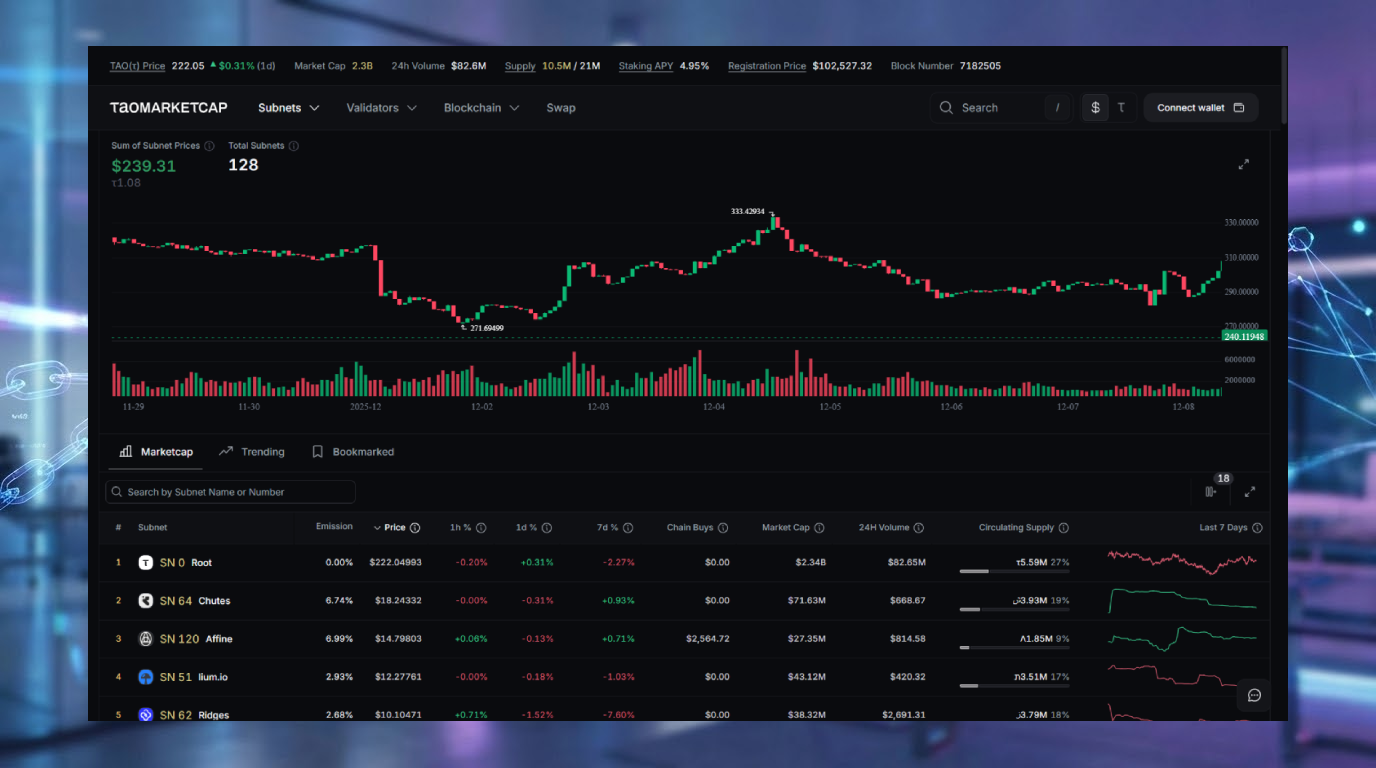
Datura is a U.S.-based platform providing access to 32 Bittensor subnets along with their documentation. Built for users working with decentralized machine learning networks, the platform makes it easy to explore, understand, and interact with subnet data — whether in text or visual format. Datura is built with usability and extensibility in mind, and continues to grow alongside the expanding Bittensor ecosystem.

Location: USA

Customer Profile

Customer challenges

With a strong team of AI and backend engineers already in place, Datura needed an equally capable frontend partner to take ownership of the user-facing architecture. The goal was to create a dynamic and extensible interface — one that could efficiently render complex data (textual and visual), maintain responsiveness, and offer deep interactivity as the Bittensor network evolves.

Our tasks

Build a frontend architecture using React, Next.js, and Tailwind CSS

Collaborate closely with AI and backend teams to translate complex data structures into intuitive frontend logic

Ensure robust rendering of visual and textual subnet content across 32 dynamic pages

Implement full URL-state logic for deep linking, user orientation, and navigation persistence

Set the foundation for future growth by keeping the system lightweight, modular, and maintainable

Our approach

How MaybeWorks organised the work:

After receiving the client's request, we scheduled a call to discuss the project's goals, and specific requirements. This allowed us to clarify key details, understand challenges, and align on expectations for the collaboration.

Using the collected information, we selected the best fit from our in-house team and managed the onboarding process ourselves.

The developer joined the project a week after the client contacted us, which allowed us to start work quickly and maintain the momentum of incremental growth.

Our outstaff manager monitored the developer's performance to ensure consistent results.

If necessary, and with the client's approval, our technical leaders were involved to solve complex problems.

We provided direct communication with the developer via Slack, while task tracking and scheduling were carried out in Jira.

Execution details

Execution period

13 month

Provided resources

1 Frontend Developer

Technology stack

Frontend:

React, Next.js

Styling:

Tailwind CSS

Language:

TypeScript

Ready to grow your team just as fast?

We'll select the perfect developer from our in-house team to sustain and boost the incremental growth of your project. Shall we discuss your tasks and requirements?

Results

MaybeWorks delivered a robust frontend layer that matched the complexity and depth of Datura’s backend. We implemented subnet-specific routing, image-based navigation, input validation, and shareable URL states — all wrapped in a performant React/Next.js architecture. Our contribution became a stable visual entry point to one of the most advanced decentralized AI ecosystems in production.

Modular architecture.

Build a modular, scalable frontend architecture using React and Next.js.

Dynamic data rendering.

Built a frontend capable of adapting to diverse subnet structures and displaying real-time outputs in both textual and visual formats.

Seamless backend integration.

Designed clear data contracts and rendering pipelines for syncing with complex backend and AI-generated data without loss of context.

Growth-ready ecosystem support.

Delivered a platform-agnostic frontend layer that can easily accommodate future tools, contributors, and analytics capabilities.
Our Team
Project Image

MaybeWorks IT outstaffing: better structure, smoother navigation

Working with Datura, we helped improve the usability and scalability of their Bittensor subnet explorer. Our developer added support for 32 subnet pages, enabled visual navigation with image menus and arrows, and introduced validation and synapse type filtering via URL states. These updates made the interface clearer for users navigating deep technical content — while keeping the codebase ready for rapid future development.

Let’s find the right talent
for your project

CONTACT US

We’ll provide you with strong developers and help you grow your team quickly. Leave a request, and we will provide you with a quote in 24 hours.

See related use cases

Discover how organizations of all sizes scale their teams with flexible IT outstaffing solutions. See how partnering with MaybeWorks drives growth, efficiency, and innovation, helping businesses stay ahead in the evolving tech landscape.